Tag: Personal Growth

  • The Practice of Knowing Your Story

    The Practice of Knowing Your Story

    In the last post, I introduced TrivesLiv™—the capacity to remain rooted in what has shaped us, hopeful about what can be, responsive to what we are learning, and aligned in how we act. We begin with the story we’re already carrying, whether we’ve looked at it or not.

    “What is your story?” I asked my client.

    He answered with his résumé. Position by position. Award by award. Education, accomplishments, recognition.

    So I asked it differently. “That’s what you’ve done. What relationships and experiences have shaped you?”

    A puzzled look crossed his face. “I don’t know. I guess I just do what I think is right—what I’ve seen my supervisors do in similar situations. It seems to work.”

    If I asked you the same question, what would you say?

    His answer isn’t unusual. We tend to think of our story as what we’ve accomplished: the places we’ve worked, the roles we’ve held, the challenges we’ve overcome. But our story also holds the people, cultures, successes, disappointments, and transitions that have shaped how we see ourselves, others, and the world.

    And it quietly tags along into our leadership:

    • Assumptions about what a good leader does, and doesn’t do
    • Habits of response when things get difficult
    • Lessons about what earns approval and value
    • Beliefs about ourselves, or others, that limit us

    When we don’t know the story we’re carrying, we’re surprised when things go sideways. We blame the circumstances, or other people. We write it off as “just how I am.” We keep pressing forward without hearing what the moment might be teaching us.

    Knowing your story gives you a choice about what you carry forward.

    The Chapters We Avoid

    Some chapters are easier to leave unexplored. Experiences, relationships, or beliefs we would rather not revisit can still shape how we see ourselves and how we lead.

    I was working with a group of leaders, inviting them to name the influences that had shaped who they were. Several pointed to faith and spirituality. One leader pushed back right away. Faith, he said, played no part in how he led.

    I asked how he’d come to that belief. For about three minutes he talked about growing up in a conservative home where faith meant attending services, keeping rules, and simple practices. Then he paused.

    “I guess it has shaped me. I’ve made a lot of decisions and relationships because I was denying its influence. I need to rethink this.”

    My part was one question. The insight was his.

    Whatever we think of a chapter, it is part of our story. Sometimes the work isn’t to agree with what shaped us, but to honestly acknowledge that it did. Only then can we choose what to keep, what to let go of, and what to carry differently.

    The Chapters We Overlook

    Painful chapters aren’t the only ones we walk past. Our best moments can hide in plain sight too. Some of the most revealing lessons come from the times we were fully engaged, connected, and at our best.

    A leader was stuck on a challenge with team dynamics. They could name the root cause, a lack of clarity, but not the next step. I asked them to think back to when things were clearest for their team.

    They paused, named a specific time, and started listing what they had done then that was missing now. The next steps came from their own story.

    Another leader felt like they were just going through the motions, and it was affecting their family. As they looked at their story, they saw a gap between their values and purpose and their current role, one that hadn’t existed in earlier roles. They were doing work they were competent at but not passionate about. Once they saw what their best seasons held, they chose to realign their work now and to keep moving toward a role that fit who their story said they were when they were most aligned.

    Our stories hold more than lessons about what went wrong. They also reveal our strengths, values, relationships, and sources of meaning—what brings us life and what we want more of in our leadership.

    What success in your story shows you where joy, learning, or strength comes alive? What would it look like to bring that into an area that feels stuck?

    A Starting Point

    Knowing your story doesn’t require having all the answers or making sense of every experience. It begins with creating space to notice what’s there and what it might be showing you about how you lead.

    This idea comes from Bill George and colleagues’* True North Fieldbook: Emerging Leaders Edition (pp. 14–15), which invites you to draw “Your Path of Life.” Here is a short variation to help you see your story beyond a résumé.

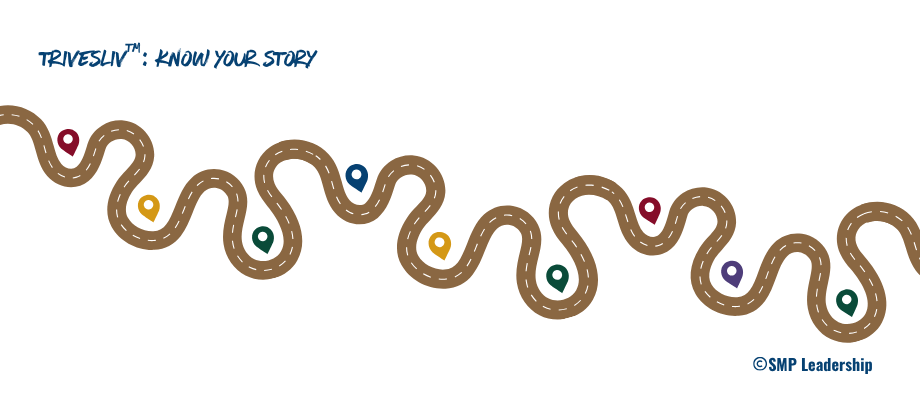
    Draw a winding road on a sheet of paper. Mark it with small hashmarks for significant events, insights, or moments. Include the difficult and the energizing. Then look at what was happening within and between the marks: how your identity, skills, and growth were taking shape along the way.

    Give it an unhurried hour. You don’t need to capture everything.

    Then, at a second sitting, look at the road again. Who was beside you at each mark? List five people who shaped how you lead. For each one, ask: What did they teach me in words? What did they teach me without words? What do I want to keep?

    Finally, ask yourself:

    • What patterns, beliefs, or assumptions do I notice?
    • What do I want to carry forward, reconsider, or do differently?
    • What is one insight I will act on?

    You’ll come back to this map again and again, adding to it each year just as a tree adds growth rings. Your story continues, and so does your understanding of it.

    Fuel hope is next: the practice of cultivating a future worth moving toward. But a future will only be as honest as the story beneath it. Until then, draw the road and notice what’s there. Which moment have you been walking past? And who will you intentionally become?


    *Contributors to the True North Fieldbook: Emerging Leaders Edition include Nick Craig, Scott Snook, Lauren Schwenk, and Josh Hall.


  • 4 PRACTICES FOR THRIVING

    4 PRACTICES FOR THRIVING

    Most of my great-grandparents immigrated from Denmark around the turn of the 20th century. They left a country that wrestled with a defining question: What do you do when the world you knew has changed—and you cannot simply recover what was lost?

    A Danish Root for Thriving

    That question had become especially sharp after Denmark’s defeat by Prussia and Austria in 1864. Denmark ceded Schleswig, Holstein, and Lauenburg, losing roughly 30-40% of the Danish monarchy’s territory. In the decades that followed over 300,000 Danes immigrated to the United States between 1870 and 1930 – including my great grandparents. During this period, a phrase came to symbolize a wider national impulse: “What was lost outwardly must be won inwardly.”

    The history is more complicated than a single slogan, but the question underneath it still matters: When circumstances change around us, what must be strengthened within us?

    That question feels increasingly relevant today. We cannot control every disruption, loss, or shift around us. But we can choose how we respond—what we carry forward, what future we move toward, what we learn, and what we do next.

    Introducing TrivesLiv™

    That is the idea behind what I call TrivesLiv. The name brings together two Danish words: trives, a verb meaning to thrive, flourish, or develop well; and liv, the Danish word for life.

    TrivesLiv (pronounced Tree-vuhs-Leev) is the capacity to remain rooted in what has shaped us, hopeful about what can be, responsive to what we are learning, and aligned in how we act.

    Thriving, in this sense, is not comfort, constant success, or avoiding difficulty. It is the capacity to stay grounded and keep becoming through change.

    In my work with individuals, teams, and organizations, I see the capacity to thrive built through four interdependent practices:

    1. Know your story. Understand what has shaped you and how those experiences influence the way you lead today. TrivesLiv leaders examine both success and failure, naming the values, strengths, hardships, and purpose they carry into the room.
      • What part of your story is shaping your leadership without your permission?
    2. Fuel hope. Cultivate a future worth moving toward. Hope is more than optimism; it gives direction and energy for action. It may be rooted in spiritual depth, meaningful aspiration, or a desire for transformation.
      • What future are you actually leading yourself (or others) toward—and can they see themselves in it?
    3. Keep learning. Stay curious enough to be changed by what you encounter. Seek perspectives different from your own, test assumptions, pay attention to feedback, and adjust when reality challenges the story you have been telling yourself.
      • Where has experience quietly become certainty—and certainty stopped your learning?
    4. Do what matters. Turn meaning and purpose into choices. TrivesLiv leaders align their story, hope, and learning with focused action—especially when the action requires courage, tradeoffs, or letting go of something that no longer serves the future.
      • What does your calendar, budget, or attention reveal about what actually matters to you?

    My great grandparents probably didn’t use these words, but I think they embodied these practices as they found a new life here. Their story was about the journey, they fueled hope with their faith and aspirations, they continued to learn, and they did the things that mattered to move toward a future that embraced the inward resolve.

    Why the Rhythm Matters

    These practices form a rhythm and they require similar attention.

    • Story without hope can leave us anchored to the past.
    • Hope without learning can become wishful thinking.
    • Learning without action becomes insight without impact.
    • Action without story or purpose can become motion without meaning.

    Thriving becomes more rooted when the four practices keep informing one another: we know what has shaped us, we fuel a future worth pursuing, we keep learning from what is changing, and we do what matters.

    Practices, Not a Promise

    TrivesLiv practices are not a promise that leaders or organizations will always flourish. Conditions matter. Systems matter. Disruption is real. The invitation is not to pretend otherwise; it is to build the inner and collective capacity to respond with greater clarity, hope, learning, and purposeful action to navigate more effectively.

    Reflection – and coaching – can create space for that work. The responsibility remains with the individual or organization: to notice the rhythm, name what is out of alignment, and choose the next faithful action.

    Where is your rhythm holding—and where is it asking for attention? That may be where your next season of thriving begins.

    In the next four posts, we’ll explore each practice more deeply—starting with the one that anchors the others: knowing your story. Before the next post, choose one of the questions above to honestly reflect on – and notice what surprises you.

  • Activate: When Alignment Becomes Action

    Activate: When Alignment Becomes Action

    There’s a moment between knowing what needs to change and actually changing —a threshold where clarity meets courage, and intention either becomes action or quietly fades back.

    You have recognized the shift in your leadership season. You’ve done the deeper work of realigning around what matters most. Now the question becomes concrete: What will you actually do differently starting Monday morning?

    Most leadership development stops at insight. We attend the workshop, read the book, have the conversation that shifts our perspective—and then we return to our desks where the same meetings, pressures, and environment are waiting. The gap between knowing and doing isn’t a lack of information. It’s the space where good intentions meet organizational inertia of status quo and comfort, competing priorities, and the challenging truth that change requires something from us beyond agreement.

    Activation is the next step of the transformation journey of closing that gap between what we are becoming more aware of and who we want to be as a leader. It does not happen through willpower alone, but through intentional, grounded choices about where you’ll invest your energy, what you’ll stop doing, and who you’ll bring along. It’s the difference between nodding in agreement about what you are discovering and taking part in the transformation process for your own better story.

    Activation isn’t vague. It shows up in specific decisions:

    • Restructuring your time: What meetings or activities will you decline? What space will you protect for the work that aligns with who you’re becoming and who you want to be? Calendars reveal priorities.
    • Changing your responses: Where will you pause to respond instead of reacting? What question will you ask before defaulting to your usual answer? Small pattern interruptions create bigger shifts over time.
    • Building accountability structures: How do you want to be accountable? Who will you tell about this commitment? What milestone on the journey will you review in 30 days? Activation without accountability becomes aspiration without traction.

    These are the building blocks of sustainable change, the kind that outlasts your initial willpower and motivation, and becomes sustainable steps towards who you want to be in each sphere of your life.

    Here is the hard reality. Activation exposes us. When we move from reflection to action, we’re no longer just agreeing. We’re testing whether our alignment holds under real conditions. That’s being vulnerable and uncomfortable. It’s also a value proposition in that we are making conscious decisions about what is most important to us. The first attempts may be awkward. Others may not understand the shift. You may face challenges—both internal and external in the form of limiting beliefs, uncertainty, and expectations.

    But lean into it. The stretching discomfort is evidence that something real is happening. Activation is challenging you to lead differently than you have before – that is the work.

    Before you move forward, get specific:

    • What is one definable action you can take this week that reflects your alignment?
    • What will you stop doing to create space for this new practice?
    • Where are you hesitating—and is it discernment or fear?
    • What support or accountability do you need to sustain this movement over time?

    Awakening created awareness. Alignment provides grounding. Activation gives you movement for purposeful steps toward the leader you’re choosing to become.

    If you’re ready to move from insight to implementation but need support translating clarity into action, reach out through the Connect page. Let’s build the plan together.