Category: Leadership

  • The Journey Begins Here: 
A Theory of Change for Leaders Who Are Ready

    The Journey Begins Here: A Theory of Change for Leaders Who Are Ready

    “Change is disturbing when it is done to us, exhilarating when it is done by us.”
    -Rosabeth Moss Kanter-

    I’ve been sitting with that quote for quite a while. Not because it’s clever, but because it’s true — and I’ve lived it from both sides.

    There have been times where a new policy or practice was mandated, but it didn’t reflect the ideas of our team – change done to us. There’s been other times when tough decisions needed to be made in the budget. Instead of mandates for adjustments, our team was asked to make recommendations to get to a certain number. Still hard, but change was done with us. There are changes that I had no control over, yet how I responded shaped the transformation on the other side. And there have been moments when a flash of innovation has hit me and I decide to change my ways of doing things – it is exhilarating as Kanter calls out in her quote.

    Those experiences plant a question I’ve continually explored: How does change actually happen — the kind that lasts, that transforms rather than just disrupts?

    Over years of walking alongside leaders, teams, and organizations in the middle of hard transitions, a pattern began to emerge. Not a formula. More like a fingerprint — the shape transformation tends to take when it’s honest, sustainable, and grounded in something real.

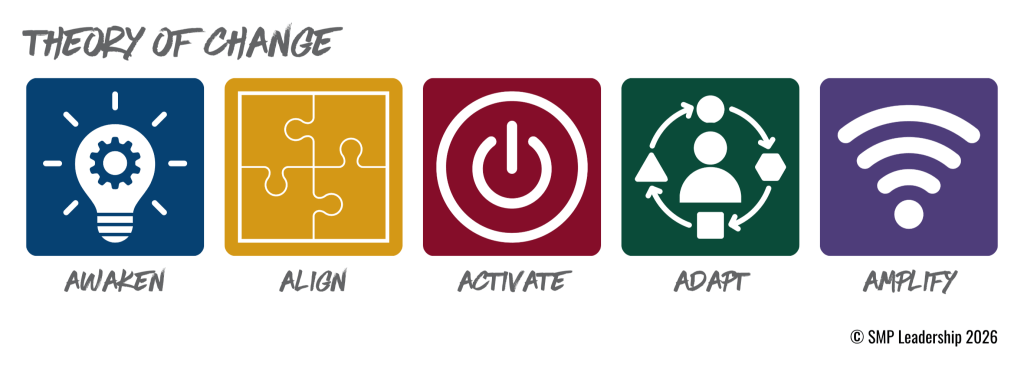
    I call it the Theory of Change, and it moves through five connected stages: Awaken, Align, Activate, Adapt, and Amplify.

    They aren’t steps to check off. They’re more like seasons — each one holding its own gifts, its own discomfort, and its own invitation.

    AWAKEN is where it starts — not with answers, but with new eyes. It’s the moment we begin to see the seasons in our own story with clarity: the assumptions we’ve carried, the possibilities we’ve overlooked, and the gap between where we are and where we want to be.

    ALIGN is about integration. As awareness grows, we have the opportunity to connect our strengths, values, meaning, and purpose into something coherent. This isn’t performance — it’s the quiet work of becoming consistent, of letting the inside and outside of our leadership tell the same story.

    ACTIVATE is where insight meets practice. This is the uncomfortable, courageous part — doing things differently, leaning into the learning edge, and discovering that the skills we need are often already present within us, waiting to be called forward.

    ADAPT is what keeps the journey alive. Real transformation isn’t a straight line. We adjust, we reflect, we recalibrate. Adapt is how we stay in the process rather than abandoning it when the first version of change doesn’t land perfectly.

    AMPLIFY is perhaps the most quietly powerful stage. It’s the recognition that our transformation — when it’s genuine — becomes an invitation for others. Not through pressure or demand, but through the influence of a life visibly changed.

    Running through all five stages is a quiet thread of reflection. Without it, change stays on the surface. With it, transformation goes towards the core.

    What I’ve seen again and again is that change done with us — change we have agency in — generates energy even through the difficulty. It doesn’t eliminate the hard parts. It gives them meaning and contributes to our story.

    So, here’s my question for you:
    Where on this journey do you find yourself right now?
    Notice it. Sit with it and maybe write it down.

    Are you just beginning to awaken? Still trying to align? Deep in the discomfort of activation? Whatever stage you’re in, you don’t have to navigate it alone — and you don’t have to have it all figured out to take the next step.

    The journey begins where you are.

    One courageous thought can interrupt old patterns and invite a new future.

    Lets connect if you would like a thought partner as you continue your journey.

  • Amplify: Leading Beyond Yourself

    Amplify: Leading Beyond Yourself

    The most enduring leadership doesn’t announce itself or demand credit—it creates conditions where others can step into their own strengths, and the work continues long after you’ve moved on.

    Here’s the paradox: the transformation you’ve experienced through Awaken, Align, Activate, and Adapt was never just for you. It was always meant to extend beyond you—into your team, your organization, your community, and even your home.

    But that extension can only be invited, not forced.

    This is where amplification begins. You awakened to what was shifting. You aligned with who you wanted to become. You activated with courage. You adapted when reality demanded it. Now amplification asks: how will this transformation extend beyond you?

    Amplification is not about scaling yourself—creating copies of your leadership style or expecting others to follow your exact journey. It’s about shaping an environment where growth becomes possible for the people around you.

    Maybe you’ve started pausing before reacting in tense moments, and now your team feels safer bringing you problems earlier. Maybe you’ve stopped filling every silence in meetings, and suddenly people who rarely spoke up are contributing ideas. Maybe you’ve admitted you don’t have the answer, and it gave others permission to be honest too.

    These may seem like small shifts. But they’re evidence that your transformation is already extending beyond you.

    Amplification requires a kind of humility many of us were never taught. You can create the conditions, but you cannot control the outcomes. You can invite others into their own transformation, but you cannot make them awaken. You can model adaptive leadership, but you cannot force others to release what they’re gripping.

    This is where humility meets stewardship.

    Your role isn’t to be the hero who fixed everything. It’s to be the leader who creates the environment for others to discover their transformation process. The credit doesn’t belong to you but to the individual who leans into their evolving journey.

    And when you lead this way, leadership becomes sustainable—because it no longer depends on you being in the room.

    I’ve watched leaders try to amplify by mandating it—rolling out new values statements, requiring reflection exercises, announcing culture shifts from the top… and then being surprised when nothing sticks.

    Real amplification is quieter, but far more powerful. It happens when a CEO who used to bulldoze through obstacles begins asking, “What are we learning from this setback?” It happens when a parent who learned to pause before reacting at work brings that same presence home—and their teenager starts opening up in ways they haven’t in years. It happens when a nonprofit executive stops being the only voice in donor meetings and brings program staff into the conversation, because their perspective matters more than her comfort.

    That is what amplification looks like: creating room for others to grow.

    And amplification doesn’t stay neatly contained in your workplace. It touches every sphere where you show up—your team, your organization, your community, your church, your home. Transformation that only affects one sphere eventually becomes a performance mask.

    Who you’re becoming shows up everywhere you are.

    And here’s what I’ve seen: when leaders amplify with humility, transformation becomes contagious—not because it’s forced, but because people witness something real and want to be part of it.

    So here are the questions worth sitting with:

    • Where has your transformation already begun to extend beyond you—and what have you noticed?
    • Where are you still trying to control outcomes instead of inviting ownership?
    • What conditions are you creating that allow others to step into their own growth?

    Amplification is the ongoing practice of leading in ways that creates room for others to lead. It’s the moment your leadership stops being about your role—and starts becoming part of the culture.

    And here is the hopeful truth:

    You don’t have to be perfect to amplify transformation. You simply have to be faithful to the work happening within you—and humble enough to let that work ripple outward.

  • Adapt: Responding with Flexibility and Faith

    Adapt: Responding with Flexibility and Faith

    Most leadership plans don’t fail on their own. They simply get interrupted by reality. And that interruption becomes an invitation to rediscover your leadership through both roots and flexibility—holding what matters while releasing what no longer serves.

    I’ve spent enough time hiking in various parks to know the route I plan is rarely the route I actually walk. The trail gets muddy. A tree blocks the path. Weather shifts. What looked like a shortcut on the map turns out to be a dead end.

    In that moment, you have two choices: insist on the original plan with frustration, or adapt.

    Adaptation isn’t abandoning the destination. It’s honoring reality without losing purpose. Sometimes it means taking the longer way around. Other times it means turning back and finding a different trailhead.

    The hikers who make it to the goal aren’t always the ones with the best plan. More often, they’re the ones who adjust to the best next step.

    Leadership works the same way. Even when you’ve awakened to change, aligned around what matters, and taken the first brave step—reality still shows up with new information. A key team member leaves. Funding shifts. The approach that worked last quarter doesn’t land this quarter. The resistance you expected comes from an entirely different direction.

    This is where leaders get stuck—not because they lack commitment, but because they confuse persistence with refusing to see what has changed.

    Adaptation requires something harder than determination. It requires discernment—the ability to distinguish between what’s essential and what’s simply familiar. It asks: What am I holding onto because it matters, and what am I holding onto because letting go feels like failure?

    It also requires faith—not the kind that denies obstacles, but the kind that trusts you can navigate them. Faith that says the destination still matters even when the path looks different than you imagined. For me, faith becomes the anchor when the plans stops making sense, and is strengthened because of deeply rooted spiritual practices, experiences, and understanding.

    Leaders who adapt well don’t do it alone. They widen the circle. They name what’s changing out loud. They ask for wisdom. They admit when the plan isn’t working instead of quietly white-knuckling their way through it.

    So here’s the question worth sitting with: Where are you holding onto tighter when the situation is asking you to adjust your grip?

    Is it a timeline that’s no longer realistic? A strategy that worked once but isn’t working now? A role you’ve outgrown? An assumption about how things should work that’s keeping you from seeing how they actually do?

    Adaptation is responsive leadership. It’s how faithful leaders stay effective when reality demands something different than they planned.

    Adaptation doesn’t mean you failed. It may be the clearest sign you’re paying attention.

    And if you’re navigating a leadership moment that’s asking for more flexibility than you know how to offer, let’s talk. Sometimes the best adaptation starts with an honest conversation.

  • Activate: When Alignment Becomes Action

    Activate: When Alignment Becomes Action

    There’s a moment between knowing what needs to change and actually changing —a threshold where clarity meets courage, and intention either becomes action or quietly fades back.

    You have recognized the shift in your leadership season. You’ve done the deeper work of realigning around what matters most. Now the question becomes concrete: What will you actually do differently starting Monday morning?

    Most leadership development stops at insight. We attend the workshop, read the book, have the conversation that shifts our perspective—and then we return to our desks where the same meetings, pressures, and environment are waiting. The gap between knowing and doing isn’t a lack of information. It’s the space where good intentions meet organizational inertia of status quo and comfort, competing priorities, and the challenging truth that change requires something from us beyond agreement.

    Activation is the next step of the transformation journey of closing that gap between what we are becoming more aware of and who we want to be as a leader. It does not happen through willpower alone, but through intentional, grounded choices about where you’ll invest your energy, what you’ll stop doing, and who you’ll bring along. It’s the difference between nodding in agreement about what you are discovering and taking part in the transformation process for your own better story.

    Activation isn’t vague. It shows up in specific decisions:

    • Restructuring your time: What meetings or activities will you decline? What space will you protect for the work that aligns with who you’re becoming and who you want to be? Calendars reveal priorities.
    • Changing your responses: Where will you pause to respond instead of reacting? What question will you ask before defaulting to your usual answer? Small pattern interruptions create bigger shifts over time.
    • Building accountability structures: How do you want to be accountable? Who will you tell about this commitment? What milestone on the journey will you review in 30 days? Activation without accountability becomes aspiration without traction.

    These are the building blocks of sustainable change, the kind that outlasts your initial willpower and motivation, and becomes sustainable steps towards who you want to be in each sphere of your life.

    Here is the hard reality. Activation exposes us. When we move from reflection to action, we’re no longer just agreeing. We’re testing whether our alignment holds under real conditions. That’s being vulnerable and uncomfortable. It’s also a value proposition in that we are making conscious decisions about what is most important to us. The first attempts may be awkward. Others may not understand the shift. You may face challenges—both internal and external in the form of limiting beliefs, uncertainty, and expectations.

    But lean into it. The stretching discomfort is evidence that something real is happening. Activation is challenging you to lead differently than you have before – that is the work.

    Before you move forward, get specific:

    • What is one definable action you can take this week that reflects your alignment?
    • What will you stop doing to create space for this new practice?
    • Where are you hesitating—and is it discernment or fear?
    • What support or accountability do you need to sustain this movement over time?

    Awakening created awareness. Alignment provides grounding. Activation gives you movement for purposeful steps toward the leader you’re choosing to become.

    If you’re ready to move from insight to implementation but need support translating clarity into action, reach out through the Connect page. Let’s build the plan together.

  • Align: The Hidden Work of Leadership

    Align: The Hidden Work of Leadership

    When pressure increases or certainty fades, the change in our leadership seasons have a way of revealing what truly grounds us. In moments like these, we rarely reach for something new. Instead, we return—often unconsciously—to what has already been formed within us. Our habits, assumptions, values, and spiritual grounding become more evident, whether we’ve named them or not.

    Like trees enduring a Minnesota winter, much of the most important leadership work happens beneath the surface. Winter offers an important lesson. Roots do not resist the season; they respond to it. Snow insulates the soil, protecting what is essential from freezing and creating the conditions needed for sustained growth. What looks dormant is actually aligned for purposeful work that you were created to complete. The unseen actions in winter makes renewal possible in every other season.

    In leadership, we often miss this opportunity. When the season shifts, we can interpret it as limiting or restrictive—something to endure or push through. But winter seasons in leadership invite alignment. They offer space to re-center around what matters most so that our responses are grounded rather than reactive, intentional rather than rushed. This alignment between our inner grounding and external reality creates capacity for growth, hope, and even joy along the journey.

    This is how change unfolds in practice. Awakening helps us recognize that something has shifted. Aligning allows us to re-center our leadership with who we want to be in this new season—before we act. From this place, we gain clarity not just about what to do next, but how to move forward with integrity and intention.

    Winter teaches us that alignment happens in stillness, not in motion. So before you move to what’s next, pause with these questions:

    • Which values, practices, or habits do I need to deepen so they can sustain growth over time?
    • What needs to shift in my environment to protect and sustain what is essential right now?
    • How am I going to align my beliefs, values, and leadership so I can respond thoughtfully rather than simply react to change?

    This kind of reflection isn’t easy. It requires slowing down when everything around you says to speed up. It means sitting with questions that don’t have immediate answers. But this is the work that matters—the work that transforms not just what you do, but who you’re becoming as a leader.

    Alignment doesn’t happen once. It’s a practice we return to whenever the season shifts, whenever pressure increases, whenever certainty fades. And each time we do, we strengthen the roots that will sustain us—and those we lead—through whatever comes next.

    If you’re sensing a shift in your leadership season and want to explore what alignment and growth could look like next, I invite you to reach out through the Connect page on the website.

  • Awakening: Recognizing the Season You Are In

    Awakening: Recognizing the Season You Are In

    Living in Minnesota, we experience seasons in unmistakable ways. The temperature shifts. The sounds change. Trees and plants signal what’s coming next. The clothes we reach for change. Even the light—how long it lingers and how early it fades—tells us something new is happening.

    And yet, how we experience each season isn’t just about the weather. Our interests, stage of life, health, and responsibilities all shape how a season feels. What energizes us in one season may exhaust us in another. What once felt familiar can suddenly feel misaligned.

    Leadership seasons change in a similar way—often just as clearly, though we’re less practiced at noticing them.

    • Teams shift through growth and attrition.
    • Roles and priorities evolve.
    • Health and energy fluctuate.
    • Programs and initiatives cycle and pivot.

    These changes can stir a wide range of emotions—energy, anxiety, curiosity, grief, motivation, and uncertainty. None of them are wrong, but they are often signals that something is changing.

    Seasonal shifts in leadership invite us into reflection. They offer an opportunity not just to adjust what we do, but to transform how we lead. Seasons remind us that leadership is not static. They call us to re-center, reimagine, realign, re-energize, and renew our perspectives and actions toward a more intentional future.

    This is where transformation begins—with awakening.

    Awakening means loosening our grip on the status quo and stepping out of autopilot. It means slowing down enough to see with new eyes. It requires knowing our own story—how past experiences, assumptions, and habits are shaping how we respond to our current reality and what lies ahead.

    Awakening starts with noticing.

    You might begin by asking yourself:

    • What am I noticing around me right now?
    • What am I noticing within myself?
    • How are the environments I’m part of shaping the shifts I’m experiencing?

    They are invitations to pay attention.

    This is the first step in a transformational journey—recognizing the season you’re in and choosing how you will meet it. You can keep moving without noticing. Or you can pause, awaken, and step forward with greater clarity and intention into what this season is asking of you. If you’re sensing a shift in your leadership season and want to explore what alignment and growth could look like next, I invite you to reach out through the contact page at SMPLeadership.com. Let’s explore the path ahead together.

  • 5 Key Strategies for Effective Coaching Preparation

    5 Key Strategies for Effective Coaching Preparation

    Having a coach to navigate leadership and life can be a new experience for many people.  Because it may be a new experience, questions about what to expect  are natural as well as questions about how to maximize the opportunity.  Being intentional with your preparation for the coaching experience will help you maximize the benefit of your coaching sessions.

    1. Commit the time on your calendar for the coaching sessions and protect it. It is also helpful to protect the time immediately before and after the session to allow you to process what you learned and are feeling as you anticipate next steps.
    2. Prepare for the sessions. Be ready to share what you have done or have not done since the prior session, and what is top of mind for you for the current session. Think about what outcomes you would like to have for the session to consider it successful.
    3. Focus. Create an environment for yourself that is free from distractions for your session. Turn off your phone, let others know you are not available, shut down other apps on your computer that might interrupt your thoughts, and remove any other things that might distract you from being fully present.
    4. Engage with a willingness to explore and reflect on what you are challenged to consider. Be willing to challenge your personal mental models and uncover limiting beliefs that may be creating barriers to your taking next steps towards your aspirations.
    5. Embrace action as you take the next steps. You are creating the next steps on the journey for yourself. The steps you prioritize are dependent on you being willing to lean into the process and grow.