Category: Amplify

  • The Journey Begins Here: 
A Theory of Change for Leaders Who Are Ready

    The Journey Begins Here: A Theory of Change for Leaders Who Are Ready

    “Change is disturbing when it is done to us, exhilarating when it is done by us.”
    -Rosabeth Moss Kanter-

    I’ve been sitting with that quote for quite a while. Not because it’s clever, but because it’s true — and I’ve lived it from both sides.

    There have been times where a new policy or practice was mandated, but it didn’t reflect the ideas of our team – change done to us. There’s been other times when tough decisions needed to be made in the budget. Instead of mandates for adjustments, our team was asked to make recommendations to get to a certain number. Still hard, but change was done with us. There are changes that I had no control over, yet how I responded shaped the transformation on the other side. And there have been moments when a flash of innovation has hit me and I decide to change my ways of doing things – it is exhilarating as Kanter calls out in her quote.

    Those experiences plant a question I’ve continually explored: How does change actually happen — the kind that lasts, that transforms rather than just disrupts?

    Over years of walking alongside leaders, teams, and organizations in the middle of hard transitions, a pattern began to emerge. Not a formula. More like a fingerprint — the shape transformation tends to take when it’s honest, sustainable, and grounded in something real.

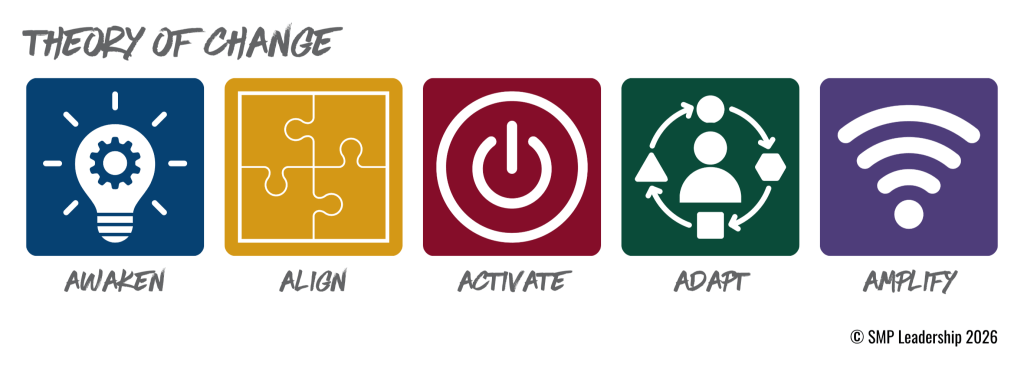
    I call it the Theory of Change, and it moves through five connected stages: Awaken, Align, Activate, Adapt, and Amplify.

    They aren’t steps to check off. They’re more like seasons — each one holding its own gifts, its own discomfort, and its own invitation.

    AWAKEN is where it starts — not with answers, but with new eyes. It’s the moment we begin to see the seasons in our own story with clarity: the assumptions we’ve carried, the possibilities we’ve overlooked, and the gap between where we are and where we want to be.

    ALIGN is about integration. As awareness grows, we have the opportunity to connect our strengths, values, meaning, and purpose into something coherent. This isn’t performance — it’s the quiet work of becoming consistent, of letting the inside and outside of our leadership tell the same story.

    ACTIVATE is where insight meets practice. This is the uncomfortable, courageous part — doing things differently, leaning into the learning edge, and discovering that the skills we need are often already present within us, waiting to be called forward.

    ADAPT is what keeps the journey alive. Real transformation isn’t a straight line. We adjust, we reflect, we recalibrate. Adapt is how we stay in the process rather than abandoning it when the first version of change doesn’t land perfectly.

    AMPLIFY is perhaps the most quietly powerful stage. It’s the recognition that our transformation — when it’s genuine — becomes an invitation for others. Not through pressure or demand, but through the influence of a life visibly changed.

    Running through all five stages is a quiet thread of reflection. Without it, change stays on the surface. With it, transformation goes towards the core.

    What I’ve seen again and again is that change done with us — change we have agency in — generates energy even through the difficulty. It doesn’t eliminate the hard parts. It gives them meaning and contributes to our story.

    So, here’s my question for you:
    Where on this journey do you find yourself right now?
    Notice it. Sit with it and maybe write it down.

    Are you just beginning to awaken? Still trying to align? Deep in the discomfort of activation? Whatever stage you’re in, you don’t have to navigate it alone — and you don’t have to have it all figured out to take the next step.

    The journey begins where you are.

    One courageous thought can interrupt old patterns and invite a new future.

    Lets connect if you would like a thought partner as you continue your journey.

  • Amplify: Leading Beyond Yourself

    Amplify: Leading Beyond Yourself

    The most enduring leadership doesn’t announce itself or demand credit—it creates conditions where others can step into their own strengths, and the work continues long after you’ve moved on.

    Here’s the paradox: the transformation you’ve experienced through Awaken, Align, Activate, and Adapt was never just for you. It was always meant to extend beyond you—into your team, your organization, your community, and even your home.

    But that extension can only be invited, not forced.

    This is where amplification begins. You awakened to what was shifting. You aligned with who you wanted to become. You activated with courage. You adapted when reality demanded it. Now amplification asks: how will this transformation extend beyond you?

    Amplification is not about scaling yourself—creating copies of your leadership style or expecting others to follow your exact journey. It’s about shaping an environment where growth becomes possible for the people around you.

    Maybe you’ve started pausing before reacting in tense moments, and now your team feels safer bringing you problems earlier. Maybe you’ve stopped filling every silence in meetings, and suddenly people who rarely spoke up are contributing ideas. Maybe you’ve admitted you don’t have the answer, and it gave others permission to be honest too.

    These may seem like small shifts. But they’re evidence that your transformation is already extending beyond you.

    Amplification requires a kind of humility many of us were never taught. You can create the conditions, but you cannot control the outcomes. You can invite others into their own transformation, but you cannot make them awaken. You can model adaptive leadership, but you cannot force others to release what they’re gripping.

    This is where humility meets stewardship.

    Your role isn’t to be the hero who fixed everything. It’s to be the leader who creates the environment for others to discover their transformation process. The credit doesn’t belong to you but to the individual who leans into their evolving journey.

    And when you lead this way, leadership becomes sustainable—because it no longer depends on you being in the room.

    I’ve watched leaders try to amplify by mandating it—rolling out new values statements, requiring reflection exercises, announcing culture shifts from the top… and then being surprised when nothing sticks.

    Real amplification is quieter, but far more powerful. It happens when a CEO who used to bulldoze through obstacles begins asking, “What are we learning from this setback?” It happens when a parent who learned to pause before reacting at work brings that same presence home—and their teenager starts opening up in ways they haven’t in years. It happens when a nonprofit executive stops being the only voice in donor meetings and brings program staff into the conversation, because their perspective matters more than her comfort.

    That is what amplification looks like: creating room for others to grow.

    And amplification doesn’t stay neatly contained in your workplace. It touches every sphere where you show up—your team, your organization, your community, your church, your home. Transformation that only affects one sphere eventually becomes a performance mask.

    Who you’re becoming shows up everywhere you are.

    And here’s what I’ve seen: when leaders amplify with humility, transformation becomes contagious—not because it’s forced, but because people witness something real and want to be part of it.

    So here are the questions worth sitting with:

    • Where has your transformation already begun to extend beyond you—and what have you noticed?
    • Where are you still trying to control outcomes instead of inviting ownership?
    • What conditions are you creating that allow others to step into their own growth?

    Amplification is the ongoing practice of leading in ways that creates room for others to lead. It’s the moment your leadership stops being about your role—and starts becoming part of the culture.

    And here is the hopeful truth:

    You don’t have to be perfect to amplify transformation. You simply have to be faithful to the work happening within you—and humble enough to let that work ripple outward.